Example: Adding Pseudo-Compounds
The following example was taken from Ind. Eng. Chem. Res. 2004, 43, No. 15, pp. 4124-4131, "Kinetics Modeling of the Autohydrolysis of Lignocellulosic Biomass for the Production of Hemicellulose-Derived Oligosaccharides", by Debora Nabarlatza, Xavier Farriol and Daniel Montane.
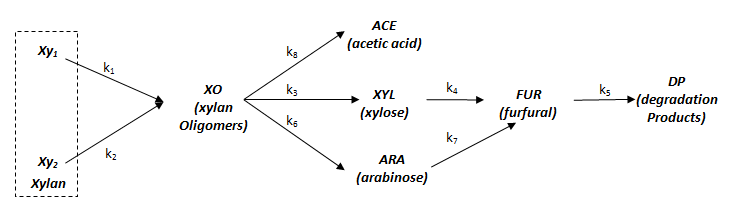
The reaction pathaway for the xylan autohydrolysis is displayed in the following figure:
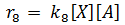
Some reactions involved have a kinetics that depends on the average composition of the xylo-oligomers. For example, reaction r8 was kinetically modelled as:
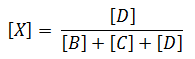
Where A represents the Xylan Oligomers XO and X represents the average Acetic Acid Composition (ACE) of the olygomer XO, that is calculated by:
Where B, C and D are the anhydrous xylose, arabinose and acetyl respectively.
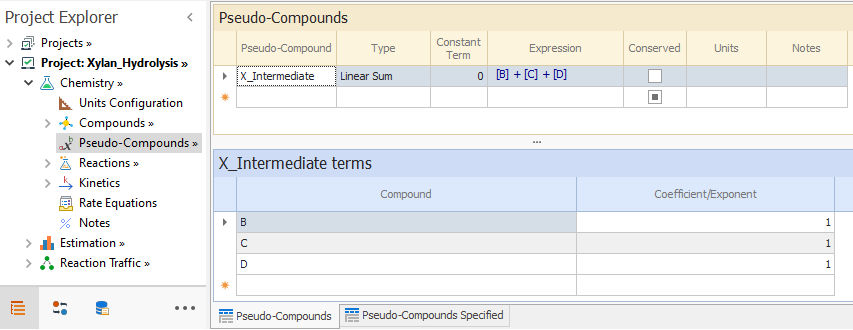
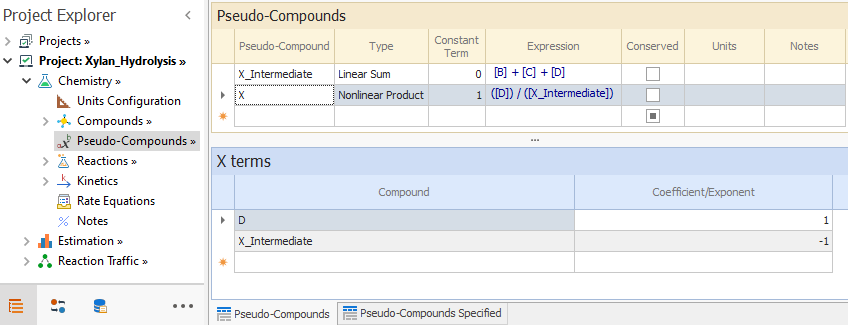
To model the r8 kinetics in REX, you may define a pseudo-compound in the corresponding node. First, an intermediate pseudo-compound X_Intermediate is defined in order to calculate the denominator in the expression.
The Linear Sum equation to be defined for the X_Intermediate pseudo-compound is then:
Having defined the X_Intermediate pseudo-compound, X is calculated by the following nonlinear relationship:
This completes the definition of the pseudo-compound X, which can now be used in the reaction kinetics.
The same mechanism is used to define derived quantities in the Derived Quantities Node.
Top of Topic
The reaction pathaway for the xylan autohydrolysis is displayed in the following figure:
|
|---|
Some reactions involved have a kinetics that depends on the average composition of the xylo-oligomers. For example, reaction r8 was kinetically modelled as:
|
|---|
|
|---|
Where B, C and D are the anhydrous xylose, arabinose and acetyl respectively.
To model the r8 kinetics in REX, you may define a pseudo-compound in the corresponding node. First, an intermediate pseudo-compound X_Intermediate is defined in order to calculate the denominator in the expression.
The Linear Sum equation to be defined for the X_Intermediate pseudo-compound is then:
|
|---|
Having defined the X_Intermediate pseudo-compound, X is calculated by the following nonlinear relationship:
|
|---|
This completes the definition of the pseudo-compound X, which can now be used in the reaction kinetics.
The same mechanism is used to define derived quantities in the Derived Quantities Node.
Go back to: